

Monday, June 10, 2013


Tuesday, June 4, 2013

Tuesday, May 14, 2013

Thursday, May 2, 2013
TWITTER TRIVIA- holiday moods
People’s tweets get significantly more positive in mood the greater the distance they are from home.
Feeling low? Over-worked, anxious, bored with life? A holiday will do your mood a world of good, there’s scientific proof. This is the latest dispatch from an emerging discipline in which social-networking media are mined to gauge people’s moods and opinions. Twitter is one of the most fertile sources of information for this kind of study, partly because comments are less guarded and self-conscious than responses to questionnaires (the social scientist’s traditional means of sampling opinion) but also because huge amounts of data are available, with automatically searchable content. What’s more, Twitter feeds sometimes come accompanied with useful information such as the tweeter’s profile and location.
Previous studies in the field of “twitterology” have, for example, monitored the spread of news, the demographics of different languages, and the correlations between obesity and expressions of hunger in particular populations. Since changes in public mood like brewing social unrest will show up on Twitter and other social media, governments, police forces and security organisations are showing an increasing interest in mining networks, raising questions about the right balance between privacy and security. Meanwhile, spotting the emergence and propagation of trends are a gift to marketing departments.
The new study of the link between happiness and geographical location takes advantage of the “garden hose” public-access feed for Twitter, which makes freely available a random 10% of all messages posted. This provided the researchers with four billion tweets from the year 2011 to analyse.
The researchers were interested in how the mood expressed in the messages correlated with the location from which they were sent, they sifted through this immense data set to pick out those tweets that were accompanied by the precise latitude and longitude of the sender’s mobile phone – a facility optionally available for tweets, which uses the Global Positioning System (GPS) to locate the message’s origin within a 10m (32ft) radius. About 1% of the messages included this information, giving a data set of 37 million messages sent by more than 180,000 individuals from all over the planet.
However, identifying where the sender is situated doesn’t in itself reveal what the researchers wanted to know. They were interested in how the message content varied with distance from home. But how could they know where “home” was?
It turns out that positional information disclosed by our mobile phones reveals this pretty clearly. In 2008 a team of researchers in the US used the locations of mobile phones – recorded by phone companies whenever calls are made – to track the trajectories of 100,000 (anonymised) individuals. They found that, as we might imagine, we tend to return over and over again to certain places, especially our homes and workplaces, and only rarely venture very far from these locations.
In much the same way, researchers could figure out the most common locations for each individual in their survey, and how widely the person tended to roam from those places. They found that people generally have two such preferred locations, just a short distance apart, which they attributed to the home and workplace.
How, then, do the messages differ when individuals are at home, at work, or further away? To assess the “happiness” of a tweet, the team of scientists developed what they call a ‘hedonometer’: an algorithm that searches the text for words implying a positive or enjoyable context (such as “new”, “great”, “coffee” and “lunch”) or a negative one (“no”, “not”, “hate”, “damn”, “bored”). On this basis the ‘hedonometer’ assigns each message a happiness score.
The findings report that the average happiness score first declines slightly for distances of around 1 km (0.62 miles) – the kind of distance expected for a short commute to work – and then rises steadily with increasing distances of up to several thousand kilometers. What’s more, individuals with a larger typical roaming radius use happy words more often – a result that probably reflects the higher socioeconomic status of such jet-setting types.
So it seems we’re least happy at work and most happy when we are farthest from home. At least, that’s the case for the roughly 15% of American adults who use Twitter, or to be even more cautious, for the English-speaking subset of those who chose to ‘geotag’ their tweets. One key question is whether this sample is representative of the population as a whole – Twitter is less used among older people, for example. It’s also an open question whether expressions of happiness in tweets are a true indicator of one’s state of mind – are you less likely to tweet about your holiday when the weather is awful and the family is fractious? But such quibbles aside, you might want to consider that costly flight to Bermuda or Kathmandu after all.
Wednesday, May 1, 2013

Sunday, April 7, 2013
DAMNED! The curse of the Vembanad.

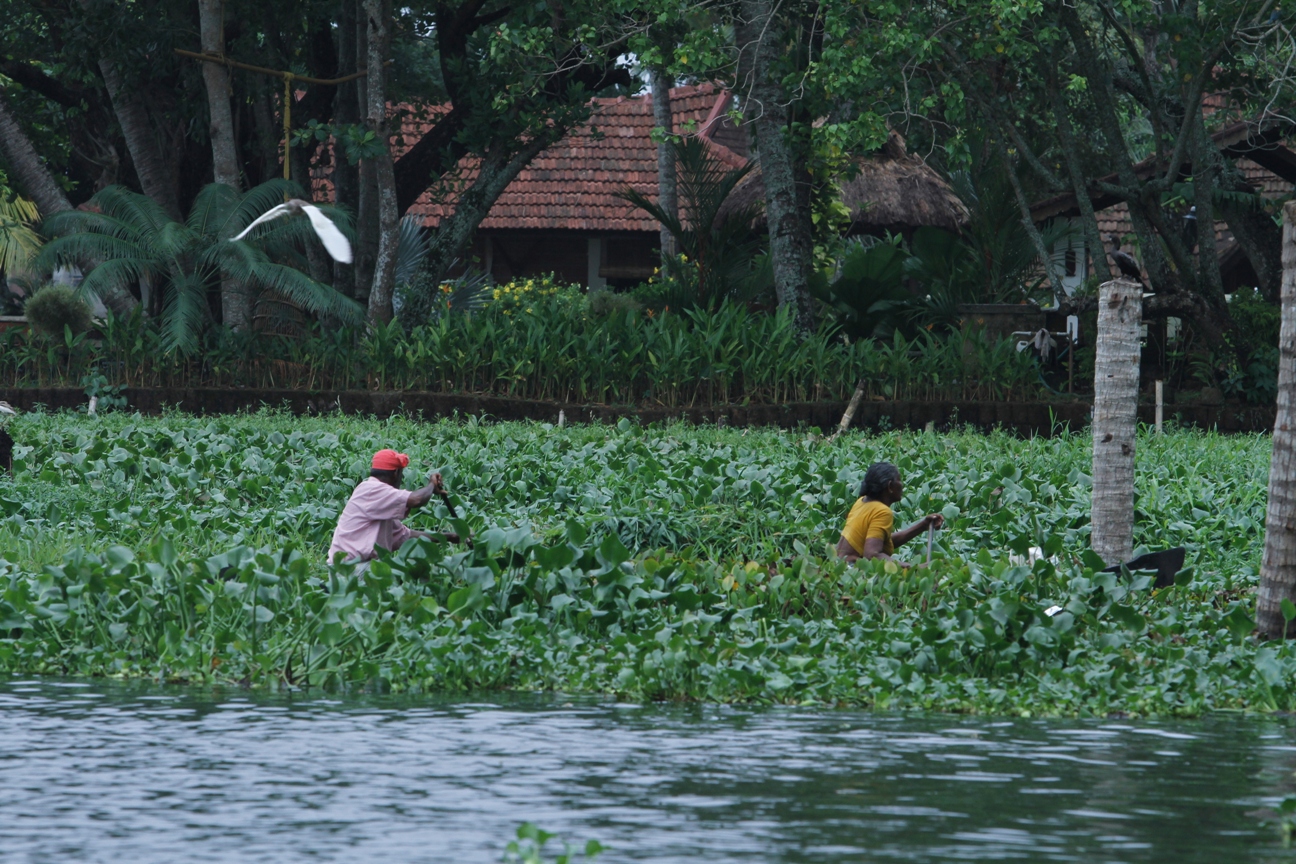
India's band-tailed (Palla's) fish eagle, a relative of the bald eagle is threatened by a number of anthropogenic factors and is listed as Vulnerable on the IUCN Red List (2012). In India, home to one of three major breeding populations for this bird of prey, the species is in great jeopardy from an invasive species. The introduction and spread of water hyacinth in the backwaters of Kerala has challenged the ability of this raptor to fish. Water hyacinth---a free-floating perennial aquatic plant native to South America has spread over all the lakes in the backwater making the finding of prey difficult. Despite its widespread distribution this bird is rarely seen in some range countries with breeding populations. (J. Schaul)

BAR HEADED GOOSE -The world's highest flying migratory bird

India's bar-headed goose is the world's highest flying migratory bird. They don't just fly by Mt. Everest on their way to breeding grounds---they fly over it along with other high peaks that comprise the Himalayan range. They breed in Central Asia and winter in South Asia (Jordan S.)
Sunday, March 17, 2013


Tuesday, February 12, 2013
A journey home? Traveling with a sense of responsibility.
 |
| Afternoon Vembanad Lake - note the floating beer bottle . Please travel responsibly, this environment is fragile. As is our planet. |
Sunday, February 10, 2013
Country boat rides - Kayaloram Lake Resort
 |
| A group of women travel in a country boat on the Vembanad Lake |

Saturday, February 9, 2013


Tuesday, February 5, 2013
Eravikulam National Park to close

The Eravikulam National Park, abode of the highly endangered , (Nilgiritragus hylocrius), will remain closed to visitors till April 4. Chief Wildlife Warden V. Gopinathan said the two-month closure was an annual affair during the calving season of the tahrs.
The closure was ordered on the basis of a report submitted by K.V. Subramanian, Field Director (Project Tiger), that the calving season of these mountain goats had begun at the park. Mr. Subramanian told The Hindu that kids were seen from the later part of January. Many of the female tahrs were heavily pregnant.
The mating season of the tahrs is between June and August and the gestation period is nearly six months. Females give birth to a single calf, though occasionally a mother with two kids has been observed. Births peak during February, and the kids are instinctively wary of human presence.
Mr. Subramanian said the newly born calves were very vulnerable to disturbances and diseases. The kids followed their mothers for the first two months and were weaned in six months. He said the calves accompanied their mothers to the Rajamala tourism zone of the 97 sq km park. But the large number of visitors to the tourism zone made the calves vulnerable to contracting diseases.
Mr. Subramanian said the tahr population at the park was stable at around 800. An estimate taken in 2010 showed the population as 776; in 2011 it was 831, and in 2012, 789. The number of kids during the calving season was estimated at 70. Wild dogs, leopards, and even tigers are the main predators of the Nilgiri Tahr. Disease and accidents also claim some of them.
The adult males are called saddlebacks since they develop a light grey area on their backs. The Nilgiri tahrs are the only species of Caprine ungulates found south of the Himalayas. The tahr, the State animal of Tamil Nadu, which was driven to the brink of extinction during the second half of the 19th century made a spectacular comeback mainly owing to the early interventions of the Nilgiri Game Association and the Wildlife Protection Act, 1972. There are now plans to reintroduce the tahr in its original habitats of Glenmorgan Mountains in the Nilgiris and the Thirukurungudi mountain ranges of the Kalakad-Mundanthurai Tiger Reserve in Tamil Nadu from where it disappeared years ago.
-Courtesy The Hindu
Friday, February 1, 2013

Thursday, January 3, 2013

Wednesday, December 26, 2012
Saturday, December 22, 2012

Friday, December 21, 2012

Subscribe to:
Posts (Atom)